The person behind the record
Life
I grew up in Waldron, Indiana, out in the country, around farming. Small town, the kind where everyone is close and everyone helps. That is still my default setting for how living ought to feel.
Home
Greenfield, half country and half not
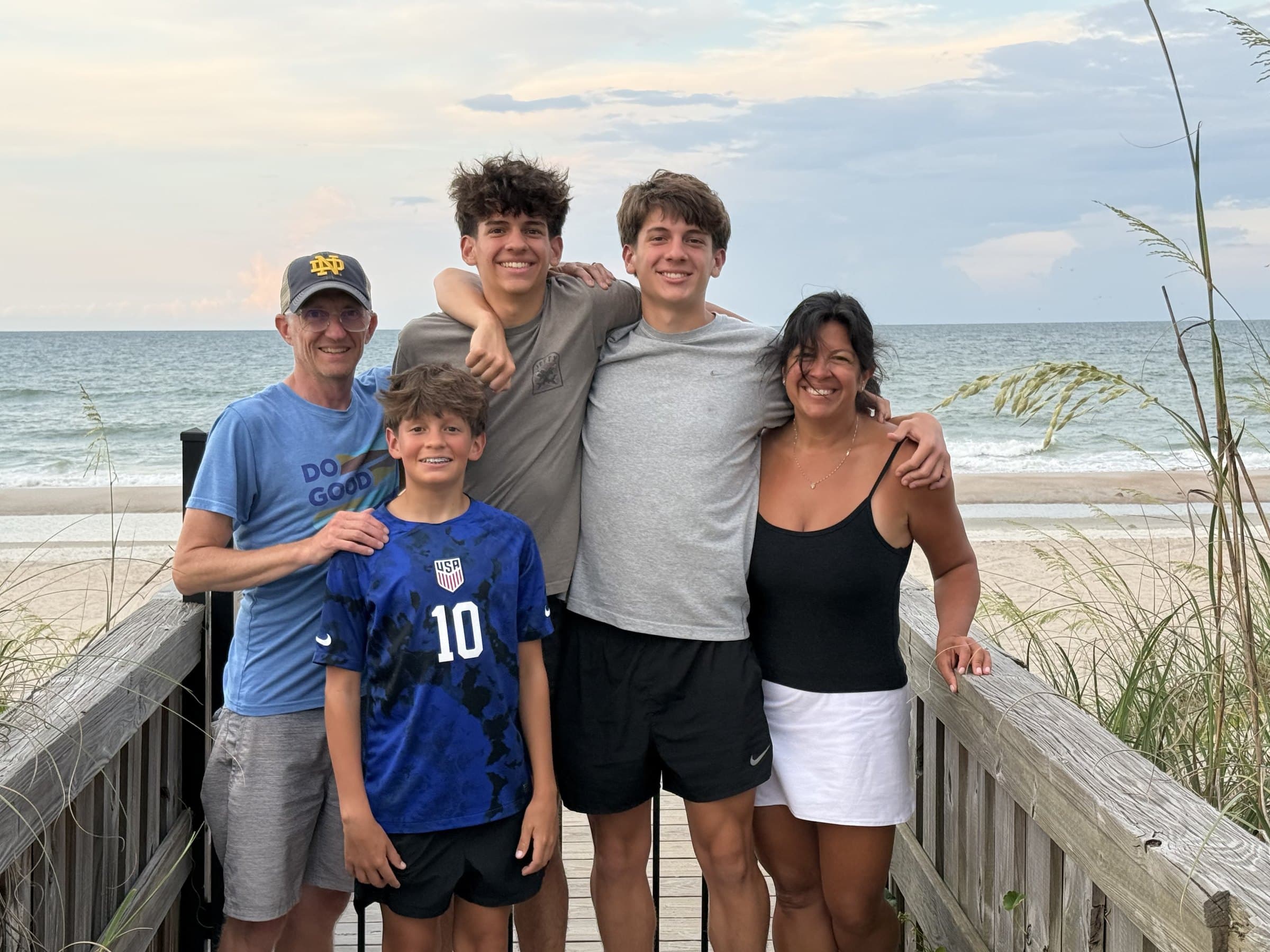
Melanie teaches kindergarten in the Greenfield-Central schools. We have three boys, Baron, Conrad, and North, seventeen, sixteen, and thirteen.
Melanie took the job in Greenfield while I was at DePuy up in Warsaw, so we bought a house in the area. We spent ten years in a neighborhood, then built our own place on three acres, closer to the country without leaving town entirely. She is a city girl. This is our happy medium.
It has been a good place to raise the boys. They have real outdoor responsibilities and enough room to do whatever we want without the usual limits of a subdivision.
Saturdays
Mostly a logistics problem
All three boys are deep in soccer, with track and basketball around the edges, so most Saturdays are multiple games in multiple places.
When we are not running to practices, Melanie and I are in the garden. Large flower and vegetable beds and a small orchard. We hit the local farmers markets when the schedule allows, and we like having people over.
How I operate
Start small, produce, iterate
When you start a company you fail constantly, in small ways, all the time. The goal is to learn from each of those small failures so you never take the large one. People always want the story about the single catastrophe. There isn't one, and that is the point.
I test what is working and what is not, more or less continuously. I worry about failing, which is most of why I work hard and try to work smart. Failure keeps happening inside successful businesses. You just have to be durable enough to outlast it.
How I operate
Five times into the unknown
Five times now I have built a function that did not exist yet. That is a preference, not an accident. I like jumping into the unknown, where there is no process and no standard, because it gives you the latitude to try anything that might work. Then you iterate, and iterate, and iterate until something does.
It is not that I enjoy creating process. What works first is never the scalable version anyway. Get it working as a human first. Then figure out how to tell the machines to do it.
You can't automate what you can't define.
How I operate
Why I started at a Fortune 100
I went to Johnson & Johnson out of Notre Dame because I wanted to see how a Fortune 100 actually operates. I learned how a multibillion-dollar company strategizes and focuses, what it takes to make physical products, and what it takes to become an expert in a field you previously knew nothing about.
I always knew I would end up back in small companies and startups. That is where the energy is, and it is the kind of people those companies attract.
Right now
A gardening app nobody asked for
I am building a gardening app. It is for Melanie and me, nobody else. It tracks what I planted, what worked, what did not, and what I want to do differently next year.
It is a strange pleasure to build the thing you wished existed for years and never had the ability to make. It is also the only product I will ever ship where I do not have to listen to anyone else's feedback.
Right now
What I put in my head
I read about fifty books a year. The podcasts are in steady rotation rather than picked over, and between them they cover most of what I think about during a week.




Right now
The thing I cannot stop chewing on
Social media is nowhere near my comfort zone, so I have been making myself get better at it, automating large chunks of it and trying to find a voice that is actually mine and actually worth something, rather than one more talking head.
Three things I actually believe
Arguable on purpose
AI is magical, but it is not magic.
You can get a great answer out of Claude once. Getting that same great answer for your entire company takes thought, planning, and structure. The more deliberate the effort, the better the outcome, same as anything else. Anyone claiming they one-shotted something valuable is not telling you the whole story. AI also has to be a function every department uses, not a thing one department drives.
Plan two weeks out, not two years.
Solve the absolute smallest problem first and make it work really, really well. Then go to the next one. It feels slow, but building too big too fast means you spend your life chasing bugs, your messaging to the market gets muddled, and you lose any clear sense of what to do next. Feedback is almost impossible to organize when you are fighting on several fronts at once.
I was wrong about how few people you need.
Two years ago I thought a couple of people could cover every part of a company. For the right kind of company that is probably true. Anything with a sales cycle needs more hands than that, and so does anything with real interaction during implementation and over the life of a project. Every interaction has to be a great interaction, especially at the start.
Ask me something
the record doesn't cover.
The career brain only knows what I've written down. For anything past that, email is the fastest way to reach me and I read everything that comes in.
I keep the questions people ask the brain, so I can see what is worth adding to the record. Page visits are counted too. No cookies, and nothing that identifies you.